

Greater Seattle Life Sciences Industry in 2025: Employment, Innovation, Funding, and Market Trends
Greater Seattle is home to one of the nation’s leading life sciences ecosystems, bringing together biotechnology, pharmaceutical manufacturing, medical devices, diagnostics, digital health, and contract research organizations within a collaborative innovation environment.
The region combines world-class scientific research, advanced manufacturing capabilities, and a highly skilled workforce to support both global life sciences companies and a growing pipeline of innovative startups.
The University of Washington anchors the region’s research leadership alongside internationally recognized institutions including Fred Hutchinson Cancer Center, Allen Institute, and the Institute for Systems Biology. Together, these organizations collaborate with industry partners to advance breakthroughs in cancer research, genomics, immunology, precision medicine, and medical technologies.
This report highlights the latest employment, economic, workforce, and startup trends shaping Greater Seattle’s life sciences industry in 2025.
Key Takeaways: Greater Seattle Life Sciences in 2025
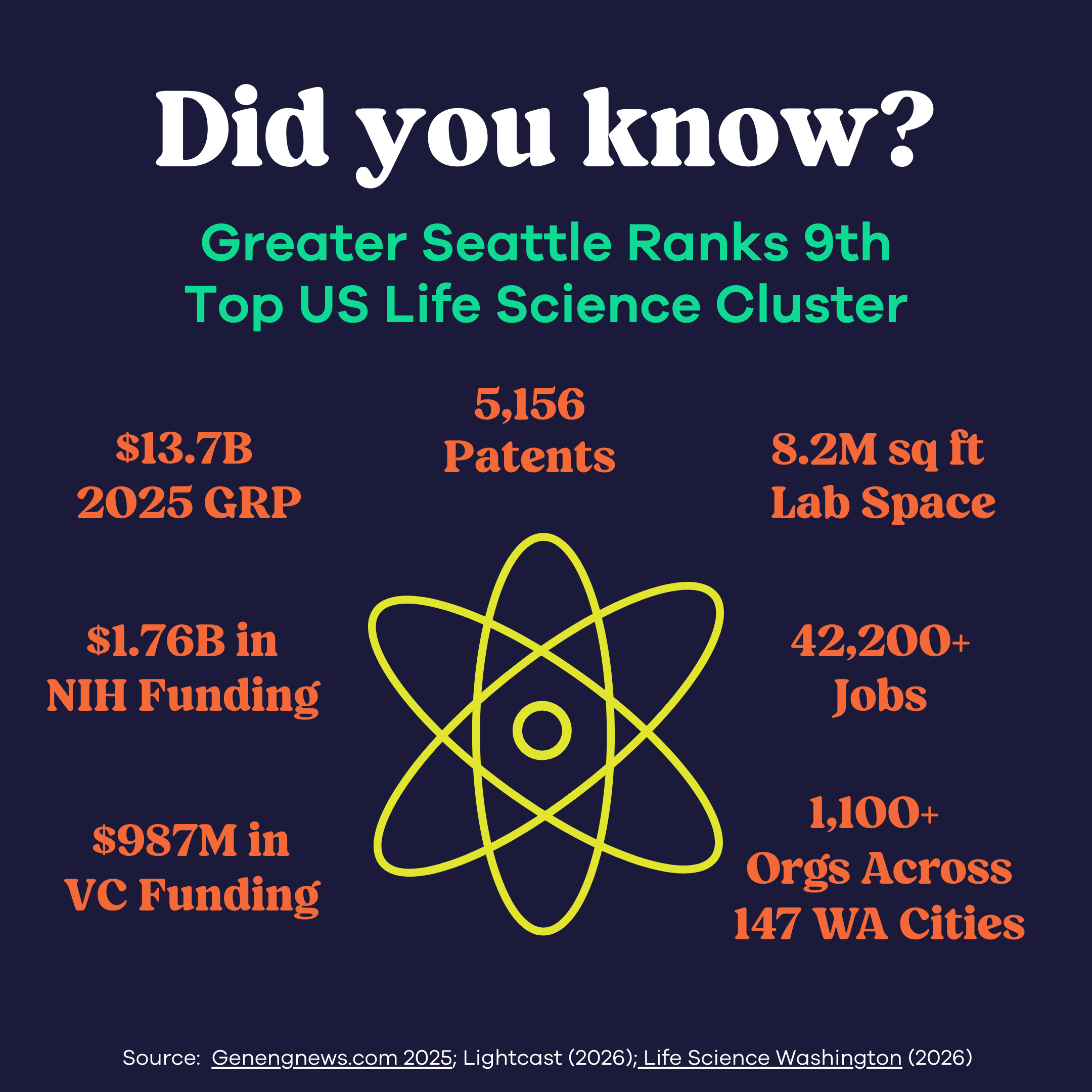
- Greater Seattle’s life sciences industry supports approximately 42,210 jobs and generated $13.7 billion in gross regional product in 2025.
- Average earnings reached $181,569 per job, reflecting the sector’s concentration of specialized scientific, technical, manufacturing, and management occupations.
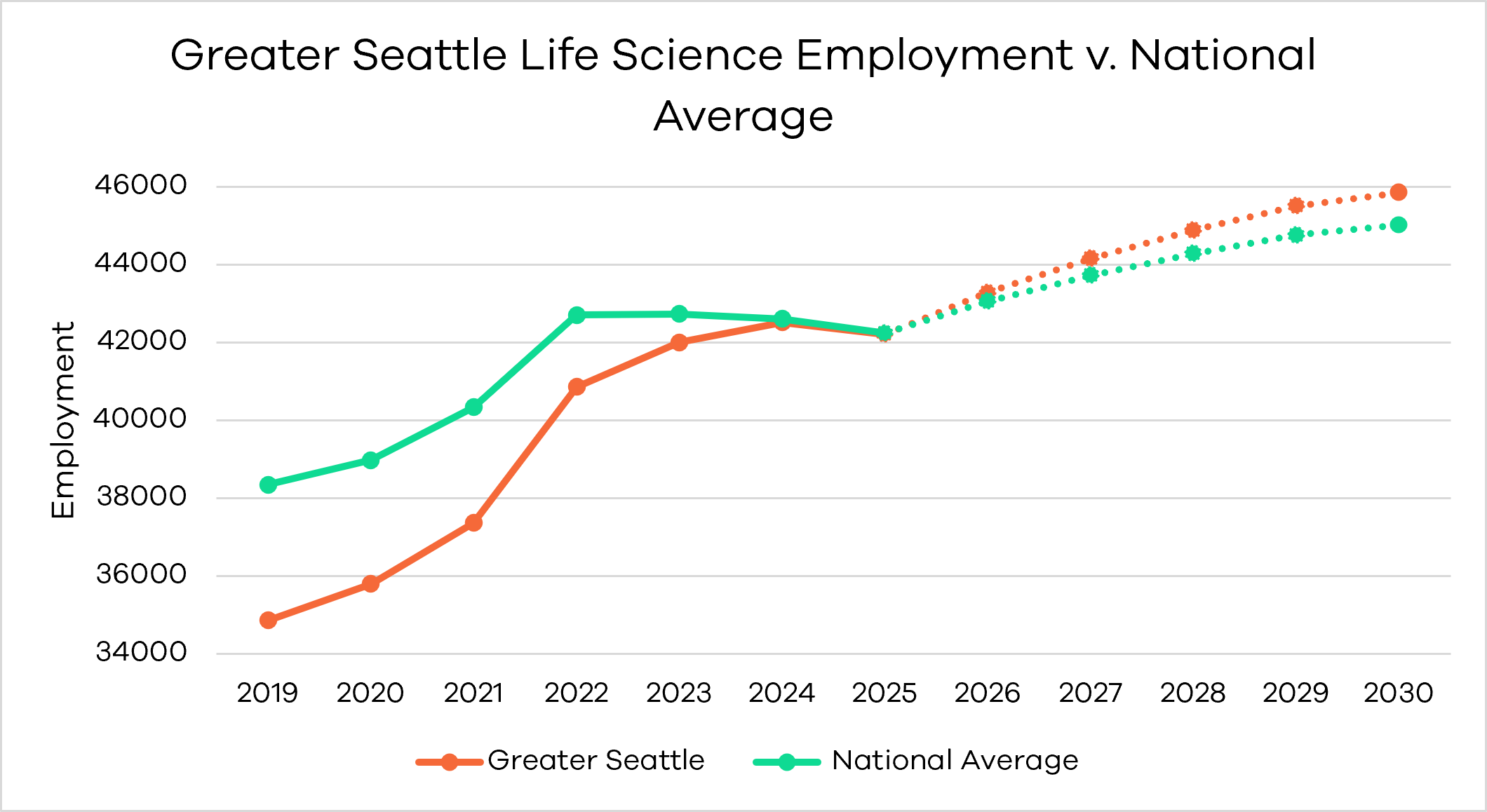
- Life sciences employment grew 18% between 2020 and 2025 and is projected to increase another 9% from 2025 to 2030, faster than the national average.
- During the past year, 649 companies posted more than 10,700 life sciences-related job openings across the region.
- Between 2016 and 2025, 179 Greater Seattle life sciences startups were founded and raised approximately $6.9 billion in total funding.
- The region’s research and commercialization ecosystem is anchored by the University of Washington, Fred Hutchinson Cancer Center, the Allen Institute, and the Institute for Systems Biology.
Billion
Gross Regional Product (2025)
Jobs
In 2025
Million
square feet (SF) of lab space
Top Life Science Cluster in the U.S.
Projected Growth 2025-2030
of jobs are held by women
Research Institutions Drive Innovation
Greater Seattle’s competitive advantage begins with its research ecosystem.
The University of Washington consistently ranks among the nation’s leading biomedical research universities and works closely with organizations including Fred Hutchinson Cancer Center, Allen Institute, and the Institute for Systems Biology to accelerate scientific discovery and commercialization.
Research strengths include:
- Biotechnology
- Oncology
- Immunology
- Genomics
- Precision medicine
- Cell and gene therapy
- Medical devices
- Digital health
This collaborative environment enables discoveries to move efficiently from laboratory research to clinical development and commercial application.
A Highly Skilled Life Sciences Workforce
The Seattle–Tacoma–Bellevue metropolitan area employs approximately 42,210 life sciences professionals, comparable to the national average for a metropolitan region of similar size.
While overall employment is similar to peer regions, Greater Seattle distinguishes itself through the quality and specialization of its workforce.
Average annual earnings reach $181,569 per employee, reflecting the industry’s concentration of highly skilled scientists, engineers, clinicians, software professionals, and manufacturing specialists.
Demand for talent remains strong.
Over the past year:
- 649 companies hired life sciences talent
- More than 10,700 job postings were advertised across the region
Hiring spans biotechnology companies, pharmaceutical manufacturers, healthcare organizations, research institutes, and emerging health technology companies.
Economic Impact Continues to Grow
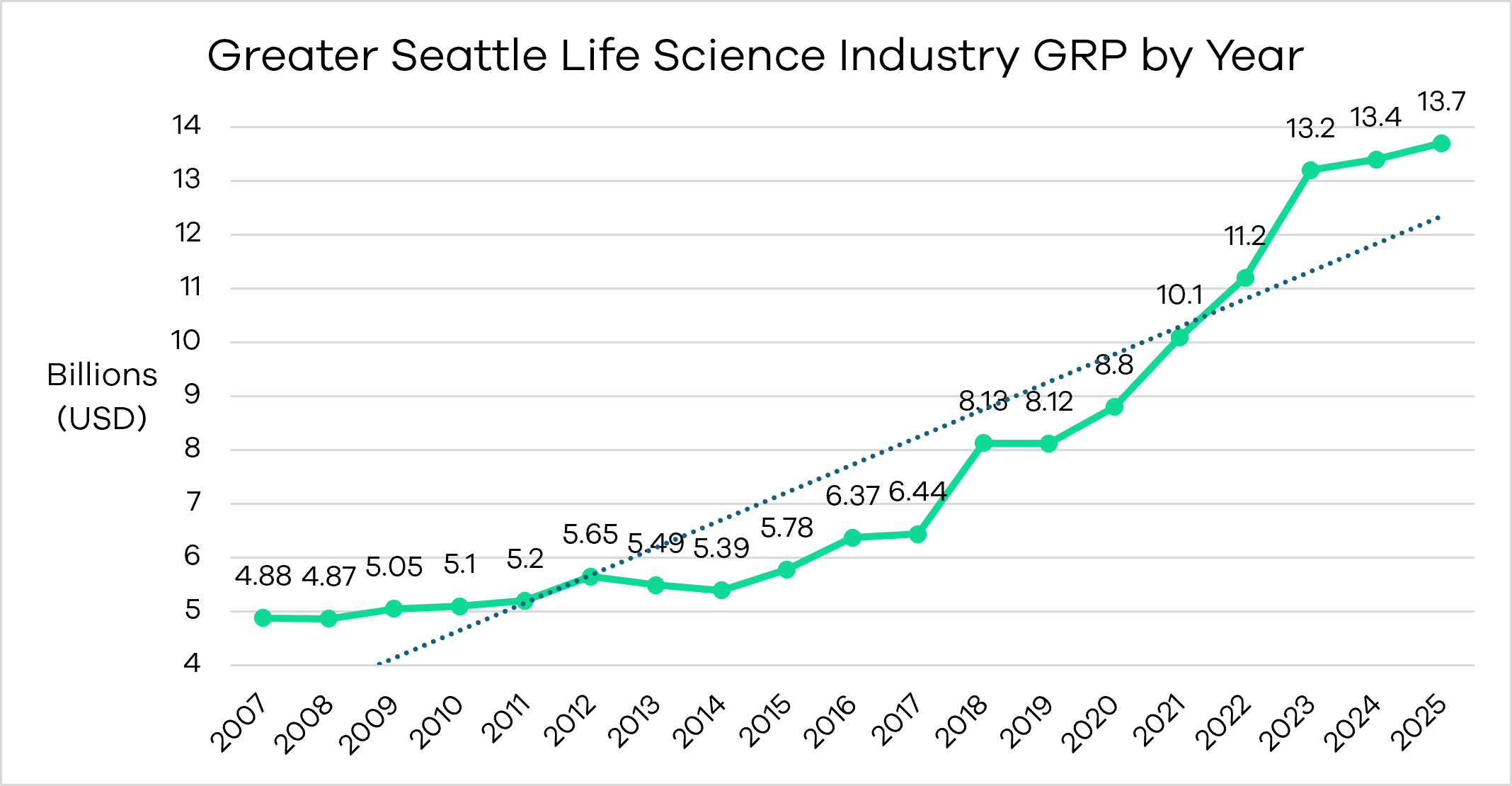
Life sciences remain one of Greater Seattle’s highest-value industries.
In 2025, the industry generated approximately $13.7 billion in Gross Regional Product (GRP), including:
- $8.1 billion in earnings
- $4.8 billion in property income
Between 2022 and 2025, the industry experienced above-average economic growth, reaching its highest recorded regional output.
Employment increased approximately 18% between 2020 and 2025, with an additional 9% growth projected through 2030, exceeding projected national industry growth.
These trends demonstrate continued expansion across biotechnology research, pharmaceutical manufacturing, medical innovation, and advanced life sciences production.
Workforce Stability Supports Long-Term Growth
Greater Seattle’s life sciences workforce is both experienced and sustainable.
A significant share of employees are between 25 and 44 years old, creating a strong pipeline of scientific and technical talent for future industry growth.
The industry also faces a lower retirement risk than the national average, supporting workforce continuity over the coming decade.
Life sciences employment spans multiple disciplines, including:
- Life, physical, and social sciences
- Computer and mathematical occupations
- Engineering
- Executive leadership and management
This multidisciplinary talent base enables innovation at the intersection of biology, engineering, artificial intelligence, and advanced manufacturing.
Largest Biotechnology Employers
The Greater Seattle region is home to both multinational pharmaceutical companies and rapidly growing biotechnology firms.
| Company | Location | Local Employment | Companywide Employment | Headquarters |
| Pfizer | Bothell | 1,500 | 81,000 | New York City |
| Bristol Myers Squibb | Seattle | 1,295 | 30,000 | Princeton, NJ |
| AGC Biologics | Bothell | 500 | 2,500 | Bothell, WA |
| Just-Evotec Biologics | Seattle | 408 | 5,000 | Seattle, WA |
| Adaptive Biotechnologies | Seattle | 378 | 650 | Seattle, WA |
Startup Innovation Continues to Accelerate
Entrepreneurship remains a defining strength of Greater Seattle’s life sciences ecosystem.
Between 2016 and 2025:
- 179 life sciences startups were founded
- Companies collectively raised approximately $6.9 billion
- Average funding reached $38.5 million per company
Startup formation accelerated between 2017 and 2021, driven by advances in biotechnology, therapeutics, precision medicine, digital health, and healthcare analytics.
The continued emergence of new companies reflects the region’s strong research institutions, experienced founders, venture capital activity, and deep scientific talent pool.
Together, startups and established organizations create an ecosystem that continuously translates research into new diagnostics, therapeutics, medical technologies, and healthcare solutions.
Top Funded Life Sciences Startups Founded Since 2016
| Rank | Organization Name | Total Funding Amount (USD) | Last Funding Type | Founded Date | Industries |
| 1 | Sana Biotechnology | 951,300,000 | Post-IPO Equity | 2018 | Biotechnology, Health Care, Life Science, Product Research |
| 2 | Truveta | 515,000,000 | Series C | 2020 | Analytics, Data Management, Health Care |
| 3 | Perspective Therapeutics | 432,600,000 | Post-IPO Equity | 2022 | Health Care, Medical, Therapeutics |
| 4 | Umoja Biopharma | 363,000,000 | Series C | 2019 | Biopharma, Biotechnology |
| 5 | Viome | 301,004,496 | Series D | 2016 | Dietary Supplements, Health Care, Medical, Wellness |
| 6 | Eliem Therapeutics | 291,302,493 | Post-IPO Equity | 2018 | Biotechnology, Health Care, Neuroscience, Pharmaceutical |
| 7 | ProfoundBio | 247,000,000 | Series B | 2018 | Biotechnology, Oncology, Therapeutics |
| 8 | Silverback Therapeutics | 221,000,000 | Series C | 2016 | Biopharma, Biotechnology, Health Care, Medical, Therapeutics |
| 9 | Outpace Bio | 199,000,000 | Series B | 2020 | Biotechnology, Health Care, Life Science, Pharmaceutical |
| 10 | Curevo | 196,000,000 | Series B | 2018 | Biopharma, Biotechnology, Health Care, Medical |
| 11 | GentiBio | 177,000,000 | Series A | 2020 | Biotechnology, Life Science |
| 12 | Shape Therapeutics | 147,500,000 | Series B | 2018 | Biotechnology |
| 13 | DexCare | 145,000,000 | Series C | 2021 | Health Care, Hospital, Software |
| 14 | Aptevo Therapeutics | 138,250,000 | Post-IPO Equity | 2016 | Biometrics, Biopharma, Biotechnology, Oncology |
| 15 | OncoResponse | 130,100,000 | Series D | 2016 | Biopharma, Biotechnology, Health Care, Oncology, Therapeutics |
| 16 | Variant Bio | 129,700,000 | Series B | 2018 | Biotechnology, Genetics, Medical, Therapeutics |
| 17 | LifeStance Health | 125,000,000 | Post-IPO Secondary | 2017 | Health Care, Hospital, Medical |
| 18 | Aurion Biotechnologies | 120,000,000 | Venture – Series Unknown | 2021 | Biopharma, Biotechnology, Health Care, Medical |
| 19 | Parse Biosciences | 99,962,500 | Series C | 2018 | Bioinformatics, Biotechnology, Genetics, Life Science |
| 20 | Lumen Bioscience | 96,950,000 | Series C | 2017 | Biopharma, Biotechnology, Life Science |
Greater Seattle’s Life Sciences Advantage
Greater Seattle offers life sciences companies a combination of capabilities found in few regions:
- World-class biomedical research institutions
- Global leaders in biotechnology and pharmaceuticals
- Highly educated scientific workforce
- Strong startup ecosystem
- Advanced biologics manufacturing
- Growing digital health and AI capabilities
- Collaborative research and commercialization environment
As investment in biotechnology, precision medicine, and advanced therapeutics continues to grow, Greater Seattle remains one of North America’s leading centers for life sciences innovation.
Frequently Asked Questions About Greater Seattle’s Life Sciences Industry
Greater Seattle combines leading research institutions, biotechnology and pharmaceutical companies, advanced manufacturing capabilities, major healthcare systems, and a highly skilled scientific and technical workforce. Collaboration among universities, research organizations, healthcare providers, established companies, and startups supports innovation in biotechnology, oncology, genomics, immunology, medical technology, digital health, and global health.
Approximately 42,210 people work in life sciences occupations across the Seattle–Tacoma–Bellevue metropolitan area. Employment grew approximately 18% between 2020 and 2025 and is projected to increase another 9% between 2025 and 2030.
The industry generated approximately $13.7 billion in gross regional product in 2025, including an estimated $8.1 billion in earnings and $4.8 billion in property income. Average earnings were approximately $181,569 per job.
Based on local employment, the region’s largest biotechnology employers include Pfizer, Bristol Myers Squibb, AGC Biologics, Just–Evotec Biologics, and Adaptive Biotechnologies. These companies represent the region’s strengths in pharmaceutical development, biologics manufacturing, immunology, diagnostics, and therapeutic innovation.
Nearly 180 life sciences startups were founded in Greater Seattle between 2016 and 2025. Collectively, these companies raised approximately $6.9 billion, averaging about $38.5 million per company.
The region’s leading research institutions include the University of Washington, Fred Hutchinson Cancer Center, the Allen Institute, and the Institute for Systems Biology. Their research, clinical programs, partnerships, and commercialization activities contribute to the formation of new companies, therapies, diagnostics, and medical technologies.
Methodology and Data Sources
This report provides a 2025 overview of the Greater Seattle life sciences industry using the most recent data available at the time of publication.
Employment, workforce, job-posting, earnings, economic-output, and growth estimates were sourced from Lightcast, 2026. Startup formation, company funding, and financing-stage information were sourced from Crunchbase, 2026. Local employment estimates for major biotechnology companies were sourced from the Puget Sound Business Journal Book of Lists, 2025.
For this analysis, Greater Seattle generally refers to the Seattle–Tacoma–Bellevue metropolitan area. Life sciences industry definitions may include biotechnology, pharmaceuticals, medical devices, diagnostics, research services, health technology, biologics manufacturing, and related scientific and technical occupations.
Funding totals reflect publicly reported financing data and may include venture capital, private equity, post-IPO financing, and other disclosed investment types. Company funding, employment, and industry classifications may change as new information becomes available.
The report was researched and written by Dr. Victoria DePalma, Greater Seattle Partners Research Director.
Other 2025 Greater Seattle Region Reports:
King County Economic Overview 2025
Pierce County Economic Overview 2025
Snohomish County Economic Overview 2025
Greater Seattle Trade Overview 2025
Greater Seattle Foreign Direct Investment Overview 2025
Greater Seattle Startup Funding and Venture Capital Trends 2025
Greater Seattle Aerospace Industry in 2025
Ready to take advantage of everything Greater Seattle has to offer?