

2025 Greater Seattle Economic Overview
The Greater Seattle region remains one of the most competitive and innovation-driven metropolitan economies in the United States. With a laid out foundation of globally recognized industries including artificial intelligence, aerospace, life sciences, maritime, and advanced manufacturing, the region continues to attract investment, talent, and business growth. The 2025 Greater Seattle Economic Overview examines the key trends shaping the regional economy, from workforce and population growth to trade, startup activity, and global competitiveness.
As a gateway to global markets, the region plays a critical role in international trade and foreign direct investment. Its infrastructure, port system, and connectivity to Asia-Pacific markets position Greater Seattle as a strategic hub for global commerce. At the same time, regional leaders are addressing structural challenges that influence long-term economic performance, including housing affordability, infrastructure capacity, workforce development, and equitable access to opportunity. Targeted investments and policy initiatives aim to sustain growth while broadening participation in the region’s prosperity.
This report examines the core drivers of the regional economy: foreign direct investment, startup formation, sector performance, trade activity, and labor market trends. The analysis is intended to inform decision-makers, investors, and partners as they evaluate opportunities in the Greater Seattle region and plan for the years ahead.
| King County | Pierce County | Snohomish County | |
|---|---|---|---|
| Median Household Income | $122,080 | $100,529 | $109,165 |
| % Foreign-Born Population | 27% | 12% | 20% |
| % Remote Workers | 21% | 13% | 16% |
| % of Commuters Taking Public Transport to Work | 8% | 2% | 4% |
| Median Age | 37.4 | 37.4 | 39 |
| Median House Value | $885,200 | $574,500 | $735,800 |
Greater Seattle Economic Overview
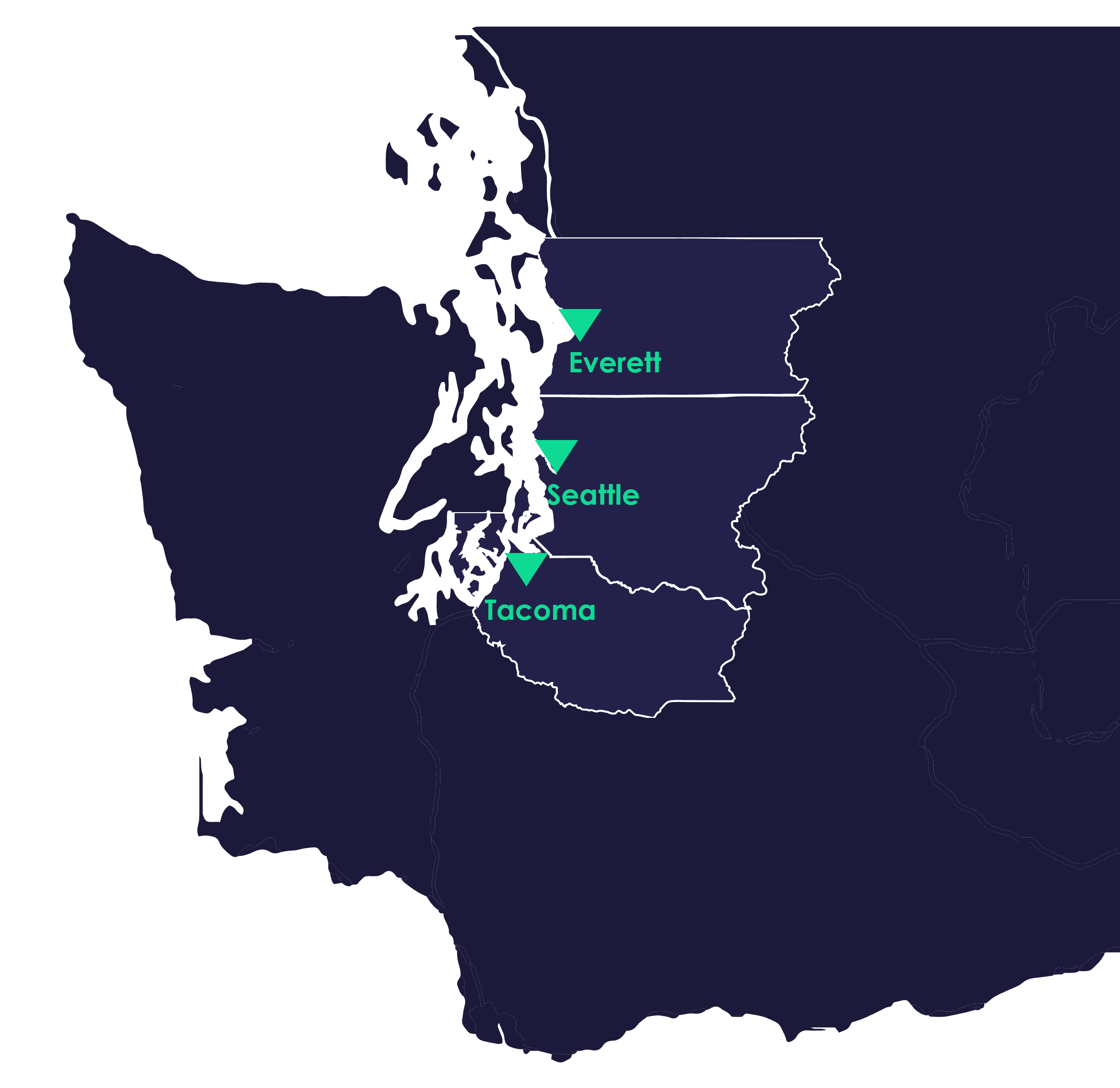
The Greater Seattle region, including King, Snohomish, and Pierce counties, forms one of the most dynamic and innovative metropolitan economies in the United States. Together, these counties make up the Seattle–Tacoma–Bellevue metropolitan area, a globally recognized center for technology, aerospace, life sciences, advanced manufacturing, and international trade.
The Greater Seattle Area generated approximately $607.0 billion in Gross Regional Product (GRP) in 2025, accounting for the majority of Washington state’s $856.5 billion economy. The region also supports more than 2.32 million jobs, representing a substantial share of Washington state’s 4.07 million total jobs. This concentration of economic activity positions Greater Seattle among the most productive metropolitan economies in North America, driven by leadership in technology, aerospace, global trade, life sciences, clean energy, and advanced manufacturing.
The region combines a highly educated workforce, world-class research institutions, and a diverse industry base that attracts global investment and talent. Major companies including Amazon, Microsoft, Boeing, Costco, T-Mobile, and Google operate across the region, supporting thousands of smaller firms and startups that contribute to a vibrant innovation ecosystem.
King County serves as the economic core of the region, home to the largest employment base and the headquarters of many global technology and corporate leaders. To the north, Snohomish County is a key hub for advanced manufacturing and aerospace, supporting major production and supply chain operations. Pierce County anchors the South Sound economy with strong growth in logistics, healthcare, government, and defense-related industries, including the presence of Joint Base Lewis-McChord.
Strong connectivity between these counties allows businesses and workers to operate within a single integrated labor market. Daily commuting patterns, shared industry clusters, and coordinated infrastructure systems link communities across the region, enabling companies to access a broad talent pool while offering workers diverse employment opportunities.
Together, the three counties support millions of residents, hundreds of thousands of businesses, and one of the most productive innovation economies in the world. This regional collaboration continues to position Greater Seattle as a leading center for global investment, talent, and economic opportunity.
2025 Population
Total Employment
Median Household Income
Labor Force Participation
Bachelor’s Degree or Higher
Companies in the Region
Population Growth and Workforce Trends
The Seattle–Tacoma–Bellevue metropolitan statistical area (MSA) remains one of the most dynamic economic centers in the United States, combining strong population growth, a highly educated workforce, and a diverse industry base. As of 2025, the region’s population reached 4.16 million residents, representing an increase of 128,186 people since 2020. Population growth is expected to continue steadily, with projections indicating the region will add another 122,471 residents by 2030.
The region supports 2.35 million jobs and a labor force of more than 2.32 million workers, continuing to be a major employment hub in the Pacific Northwest. Median household income reached $112,600, significantly above the national median, reflecting the concentration of high-value industries and highly skilled talent in the region.
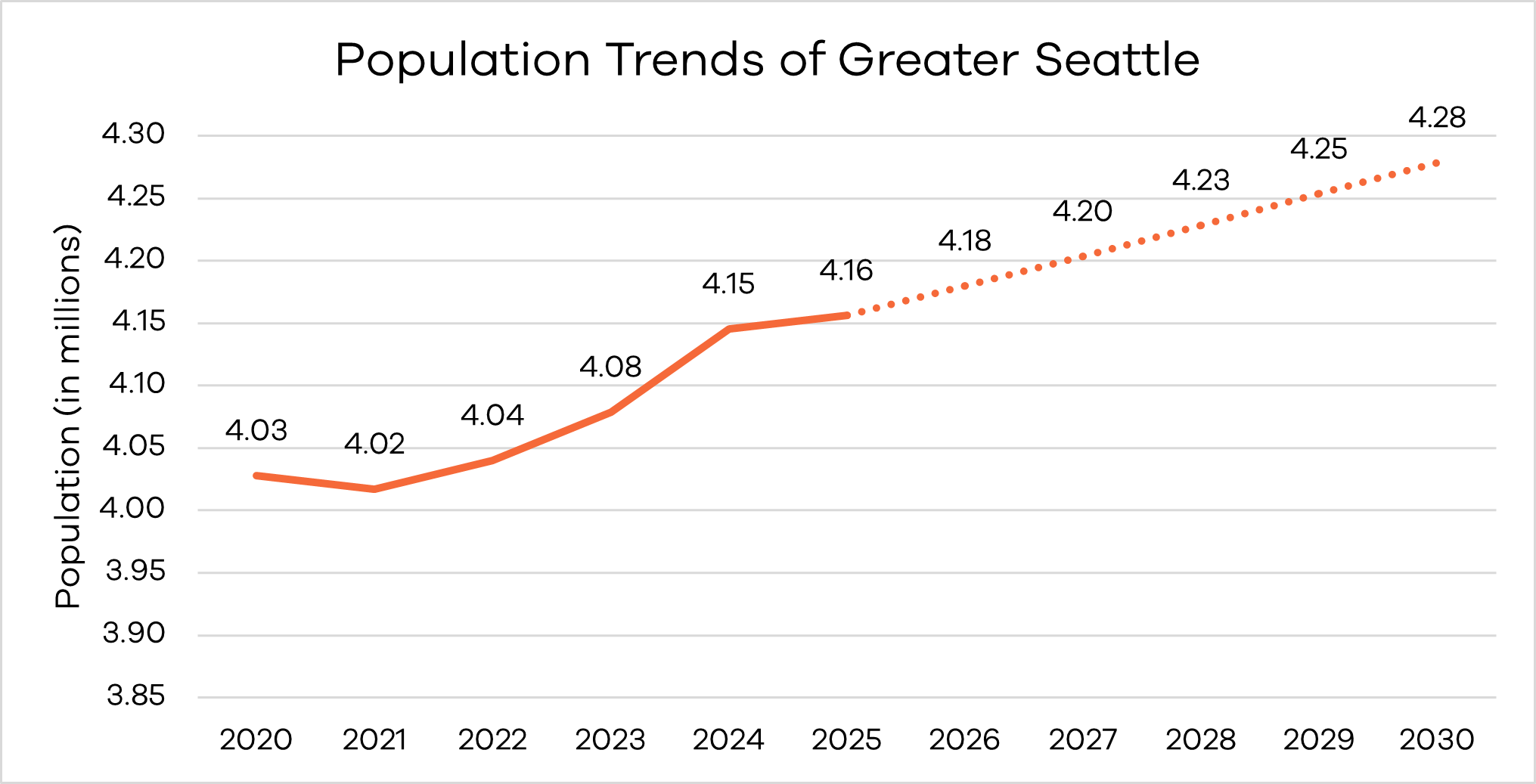
Between 2020 and 2025, the Seattle–Tacoma–Bellevue MSA region added more than 140,000 jobs, representing 6.4% employment growth. While this growth rate trails the national average over the same period, the region continues to maintain a robust and resilient labor market supported by technology, professional services, healthcare, and advanced manufacturing industries.
The unemployment rate has declined significantly from pandemic-era highs, falling from 8.86% in 2020 to approximately 5.04% in late 2025. Labor force participation has remained relatively stable near 69%, indicating a strong connection between the region’s workforce and the labor market.
Highly Educated Talent Pipeline
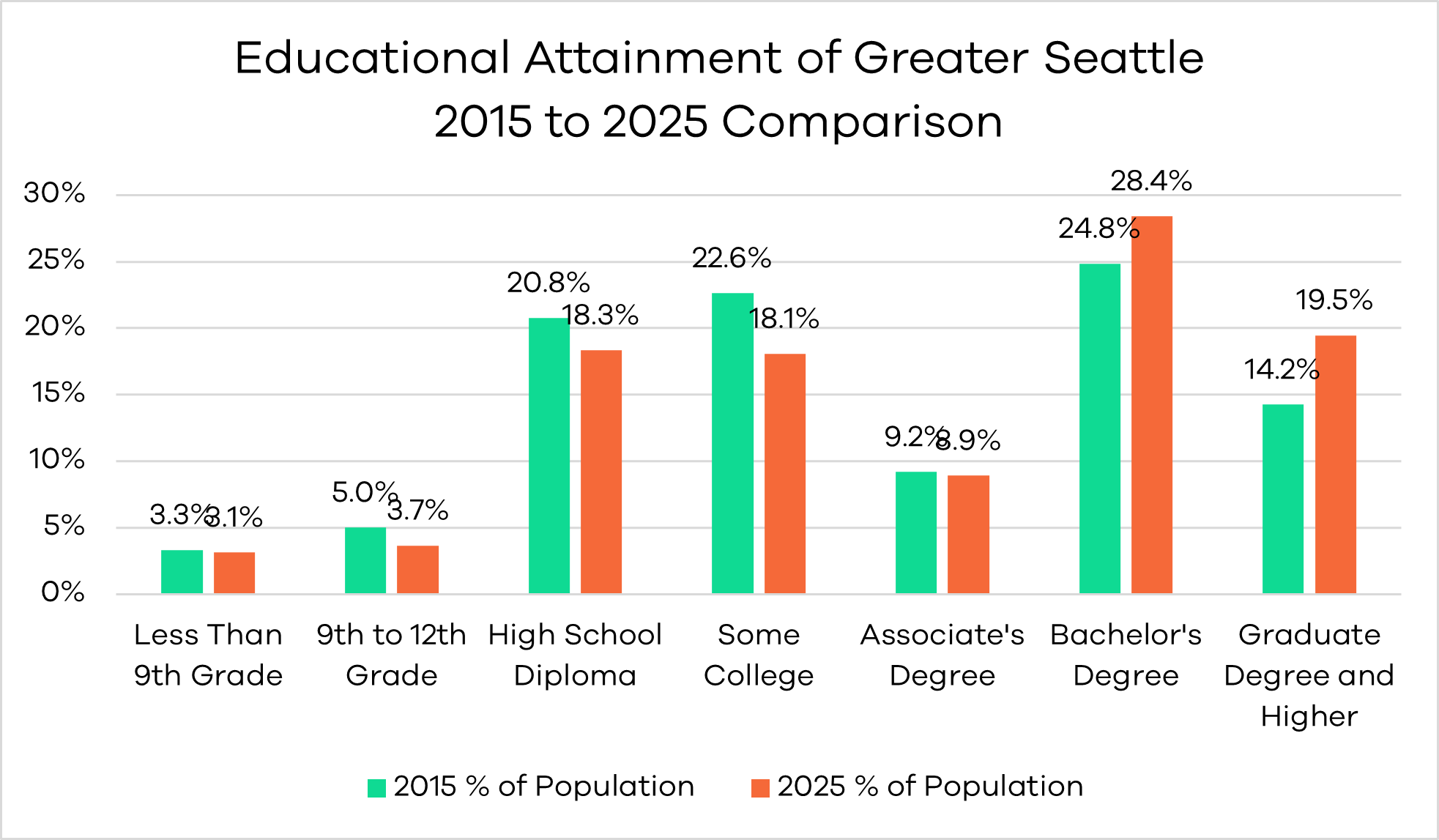
The Seattle metro area benefits from one of the most educated labor forces in the country. Nearly 28.4% of residents hold a bachelor’s degree, which is 6.6 percentage points higher than the national average, while 19.5% hold graduate degrees or higher. This deep talent pool supports the region’s innovation economy and provides a steady supply of skilled workers for technology, life sciences, engineering, and advanced business services. The region also maintains a strong educational pipeline. In 2024 alone, local institutions produced more than 49,000 graduates, led by institutions such as the University of Washington, Seattle University, Bellevue College, and Tacoma Community College.
Seattle’s population is characterized by a strong concentration of working-age residents. The region is home to more than 1.06 million millennials (ages 25–39), significantly above the national average for metro areas of comparable size. Demographic diversity also contributes to the region’s economic vitality, with 1.82 million residents identifying as part of racially diverse communities. This diversity supports a globally connected workforce and strengthens the region’s innovation economy.
Business Landscape
The regional business ecosystem is diverse and entrepreneurial, with approximately 290,000 companies employing workers in the Seattle–Tacoma–Bellevue area. The majority of firms are small businesses, with nearly 67% employing fewer than 10 workers, reflecting a strong startup and small-business culture alongside the region’s global corporations. This balance of innovative startups and major multinational employers contributes to a resilient and dynamic regional economy.
Major employers further reflect the region’s global economic influence. Companies such as Amazon, Microsoft, Boeing, the University of Washington, Google, Meta and T-Mobile collectively employ hundreds of thousands of workers and anchor the region’s technology, aerospace, and innovation ecosystems.
Looking ahead, the Seattle–Tacoma–Bellevue region is projected to continue expanding, with nearly 95,000 additional jobs expected by 2030. Combined with sustained population growth and a strong educational pipeline, these trends position the region for continued leadership in technology, advanced industries, and innovation-driven economic development.
Major Employers and Corporate Headquarters
Greater Seattle is home to one of the most concentrated clusters of global corporate headquarters in the United States. The region’s top publicly traded companies generated more than $1.35 trillion in combined revenue in 2024. A strong example of scale, diversification, and global integration of the local economy.
Washington’s Top Employers
| Company | State Employment |
|---|---|
| Amazon | 92,000 |
| Boeing | 67,565 |
| Microsoft | 54,780 |
| University of Washington | 53,536 |
| Providence Swedish | 45,597 |
Amazon, headquartered in Seattle, remains the region’s largest company, reporting $638 billion in revenue and $59 billion in net income in 2024, with a global workforce of 1.5 million employees. Alongside Amazon, Microsoft in Redmond continues to anchor the technology sector with $245 billion in revenue and $88 billion in net income, employing nearly 232,000 workers worldwide.
Retail and consumer-facing enterprises also represent a significant component of the regional economy. Costco Wholesale (Issaquah) generated $254 billion in revenue with $7 billion in net income, supporting 332,000 employees globally. Starbucks (Seattle) reported $36 billion in revenue and employs more than 237,000 people worldwide. The region’s strength in telecommunications and advanced manufacturing is reflected in T-Mobile (Bellevue), which generated $81 billion in revenue and $11 billion in net income, and Paccar (Bellevue), a global leader in commercial vehicle manufacturing with $34 billion in revenue.
Top 10 Largest Washington-Based Public Companies
| Company | Location | Revenue (2024) | Net income (2024) | Total Employees |
|---|---|---|---|---|
| Amazon | Seattle | $638B | $59B | 1,500,000 |
| Costco Wholesale | Issaquah | $254B | $7B | 332,000 |
| Microsoft | Redmond | $245B | $88B | 231,900 |
| T-Mobile | Bellevue | $81B | $11B | 70,000 |
| Starbucks | Seattle | $36B | $4B | 237,600 |
| Paccar | Bellevue | $34B | $4B | 29,800 |
| Coupang | Seattle | $30B | $154M | 95,000 |
| Expedia Group | Seattle | $14B | $1B | 16,500 |
| Alaska Air Group | SeaTac | $12B | $395M | 23,725 |
| Expediters International of Washington | Bellevue | $10B | $811M | 18,000 |
Greater Seattle’s is a global gateway with presence of e-commerce, travel, aviation, and logistics firms. Coupang (Seattle) reported $30 billion in revenue, while Expedia Group (Seattle) generated $14 billion. In the transportation sector, Alaska Air Group (SeaTac) reported $12 billion in revenue, and Expediters International of Washington (Bellevue) generated $10 billion. These companies support millions of jobs worldwide and tens of thousands across the Puget Sound region. Greater Seattle is a leading center for technology, global commerce, advanced manufacturing, and corporate leadership.
The report was researched and written by Dr. Victoria DePalma, Greater Seattle Partners Research Director.
Other 2025 Greater Seattle Region Reports:
King County Economic Overview 2025
Pierce County Economic Overview 2025
Snohomish County Economic Overview 2025
Trade Overview 2025
Foreign Direct Investment Overview 2025
Greater Seattle Startup Funding and Venture Capital Trends 2025
Greater Seattle Aerospace Industry in 2025
Ready to take advantage of everything Greater Seattle has to offer?